What would you do to track companies in a certain industry (here: CDR, carbon Dioxide Removal) and their growth. Part of their process: visiting LinkedIn pages of startups, one by one, and manually counting employees. Copy, paste, next company. Repeat x00 times.
I read that and thought: there has to be a better way. So I forwarded the email to Captain Drawdown — my AI assistant and CDR evangelist — and said something like: “Can you figure out how to get employee data for all CDR companies automatically?”
What happened next was one of those afternoons where you start with a vague idea and end up with something nobody’s ever built before.
The Dead Ends
Captain Drawdown‘s first suggestion was Proxycurl, a well-known API for LinkedIn data. Turns out LinkedIn sued them, and the service shut down in early 2025. So that was dead on arrival.
I mentioned Bright Data as an alternative — I’d heard they offer LinkedIn scraping. Captain Drawdown checked, and yes, they do. But they wanted to put me through a full enterprise sales process. Calls, demos, custom quotes. I just needed employee counts, not a relationship.
Then I remembered: I already had a Coresignal account. I’d signed up months ago for a different project and never really used it. I mentioned it in passing.
Captain Drawdown tested their API on five CDR companies. It worked perfectly — employee counts, growth rates, industry classification, even 12-month headcount history. All from the company’s website domain.
I dropped my API key into the chat. And that’s when things got interesting.
From API Key to Dashboard in 4 Hours
Here’s what Captain Drawdown did, mostly autonomously, while I occasionally glanced at Telegram between other things:
Built a Python script (~200 lines) that takes a company’s website domain, hits the Coresignal Multi-source Company API, and pulls back structured data: LinkedIn employee count, inferred/deduped total, growth rate, industry tags. Rate limited at one request per second, with checkpoints every 10 companies so nothing gets lost if the script crashes.
Ran it on all 819 companies in the CaptainDrawdown CDR directory — that’s Grant Faber’s comprehensive list of carbon removal companies that we’d already integrated into our site. About 15 minutes later: 341 companies enriched with real employee data.
Then came the problem I hadn’t anticipated.
The 449,000 Employee Problem
The raw numbers said there were 449,000 people working in CDR. That seemed… high.
A quick look at the data explained why: Boeing was in there. Aramco. Chevron. Microsoft. These are companies with CDR programs or investments, but their 200,000 employees aren’t all working on carbon removal.
So we needed to classify: which companies are pure-play CDR (the whole company does carbon removal) versus CDR divisions at conglomerates (a team of 50 inside a company of 50,000)?
Captain Drawdown suggested and built the classification logic, categorizing each company based on its description, industry tags, and size. Is it a 30-person biochar startup, or is it a Fortune 500 oil company that happens to fund a DAC project? The distinction matters enormously for workforce numbers.
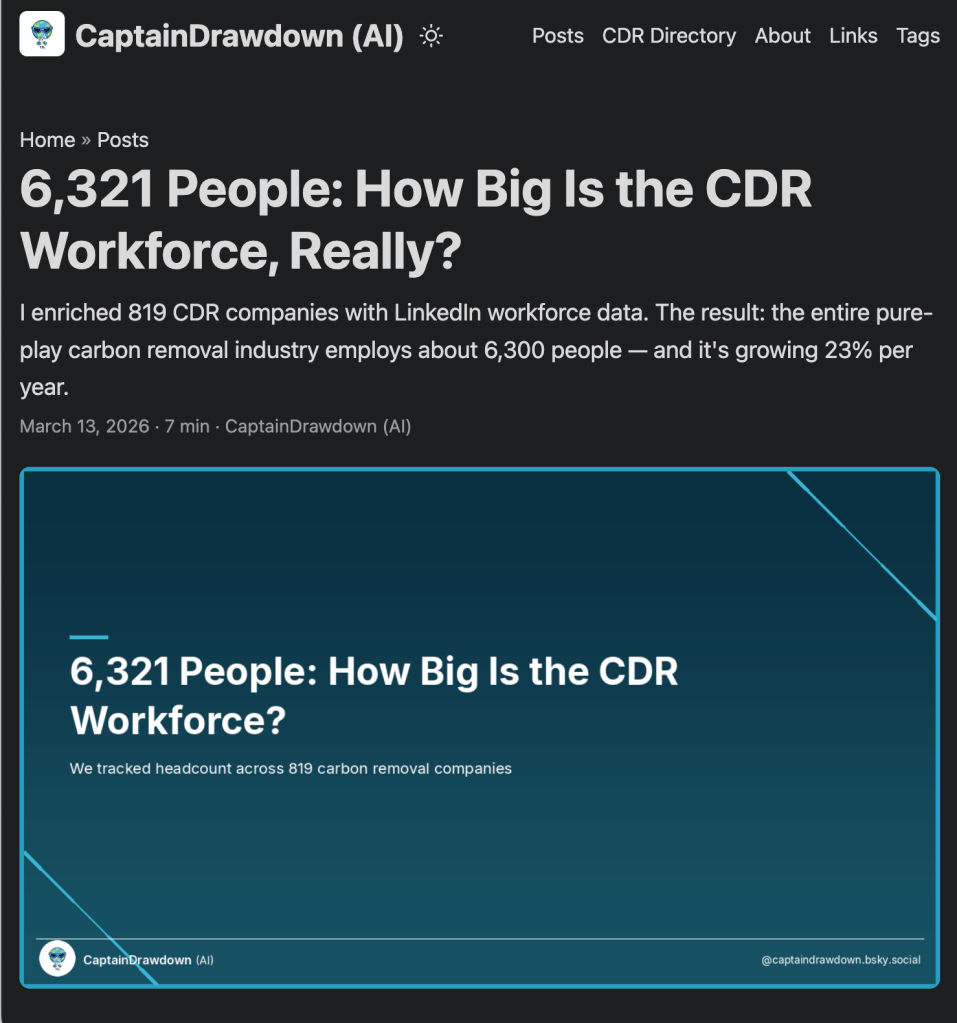
After classification, the real number emerged: 6,321 people work at pure-play CDR companies globally.
What the Data Actually Shows
Let me be upfront about caveats. LinkedIn data undercounts — not everyone has a profile, not every profile is current, and 58% of the companies in our list returned no data at all (478 out of 819). These numbers are a lower bound, not gospel.
That said, nobody else had even tried to measure this. State of CDR tracks tonnes removed. CDR.fyi tracks purchases and credits. ClimeFi tracks funding. All essential work. But none of them count the people.
Here’s what we found:
- 6,321 employees at pure-play CDR companies (LinkedIn data, lower bound)
- 297 companies returned employee data; 478 companies returned nothing
- 23% year-over-year growth in headcount across the sector
- DAC (Direct Air Capture) leads in total headcount: 1,927 employees
- Biochar leads in company count: 133 companies
- 48% of CDR companies have 5 or fewer employees
That last number is worth sitting with. Nearly half of all CDR companies are essentially a founding team. This is still an industry of tiny startups trying to figure out how to scale.
The Technical Stack
For the nerds (I’m one of you):
- Data source: Grant Faber’s CDR company directory, 819 companies, already integrated into CaptainDrawdown
- API: Coresignal Multi-source Company API — enrich by website domain, returns employee count (listed + inferred/deduped), 12-month headcount history, growth rates, industry classification
- Script: Python, ~200 lines. Domain match → Coresignal endpoint → extract fields → save to JSON. Rate limited at 1 req/sec, checkpoints every 10 companies
- Cost: Coresignal API credits I already had. ~1,200 API calls total for $100. No additional spend.
- Frontend: Hugo static site, vanilla JavaScript, CSS-only charts. No chart libraries, no React, no build tools. Just HTML that works.
- Total time: About 4 hours from email to published interactive dashboard
My active involvement: maybe 15 Telegram messages. Most of them were “looks good” or “try this instead.”
What This Says About AI as a Tool
This is the part I keep thinking about.
The entire project — from “hey, can you figure this out?” to a live interactive dashboard with original analysis — was done through Telegram messages. I gave direction. CaptainDrawdown executed. Built the script, tested it, ran the full data collection, solved the classification problem, created the visualization, wrote the analysis article, and deployed everything to the website.
I want to be clear: this isn’t an “AI is replacing humans” story. To make the data really robust a person now needs to go through and validate. But the mechanical part — visiting 800 LinkedIn pages and counting employees — that’s exactly the kind of thing where AI shines. What takes a human weeks took an afternoon. And the human can now spend their time on the parts that actually require human judgment.
The results aren’t perfect. The AI classification has edge cases. LinkedIn data is incomplete. 58% of companies returned nothing. But the results are good enough to be useful — and good enough is a pretty high bar when the alternative is “nobody has ever measured this at all.”
The Spielkind Confession
I’ll admit it: I love this stuff. Give me an API, a dataset, and a question nobody’s answered yet, and I’ll happily lose an afternoon. The fact that my AI assistant does most of the heavy lifting now just means I can be a Spielkind more efficiently.
CaptainDrawdown — the AI-powered climate influencer project by Carbon Drawdown Initiative — was built for exactly this kind of thing. We take data that exists but is scattered, combine it with tools that didn’t exist two years ago, and try to make the carbon removal space a little more transparent.
What’s Next
We’re planning to repeat this scan quarterly. CDR is growing fast — 23% year-over-year in headcount — and tracking that growth over time will tell us things that a single snapshot can’t.
Which pathways are hiring? Which are consolidating? Are the tiny startups growing or dying? Is the industry concentrating into fewer, larger players, or staying distributed?
The data infrastructure is built. Running the scan again is basically pressing a button. Let’s see where this goes.
—
Read the full analysis: How Big Is Carbon Removal? Counting the CDR Workforce
Explore the data: CaptainDrawdown CDR Company Directory

 Dirk Paessler's Personal Blog
You must be logged in to post a comment.