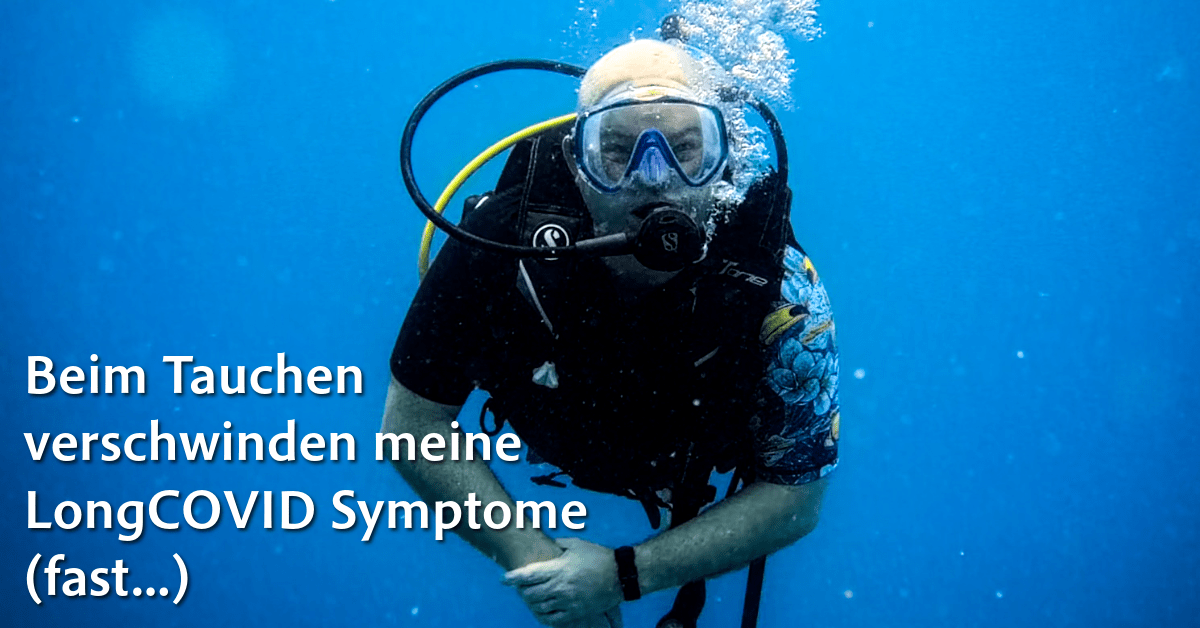
Geräte-Tauchen im Meer lässt meine LongCOVID Symptome/PEM fast verschwinden. Zum dritten Mal.

Ich habe LongCOVID. Nicht ME/CFS — das muss ich vorweg klarstellen, weil der Unterschied wichtig ist. Mein Fall ist moderat: PEM, Dysautonomie, eingeschränkte Belastbarkeit. Ich bin größtenteils funktional, aber immer mit engem Energiebudget. Menschen mit schwerem ME/CFS leben in einem völlig anderen Energierahmen — ich maße mir nicht an, von meiner Erfahrung auf ihre Situation zu schließen.

Aber was beim Tauchen mit mir passiert, ist bemerkenswert.

Continue reading “Geräte-Tauchen im Meer lässt meine LongCOVID Symptome/PEM fast verschwinden. Zum dritten Mal.”

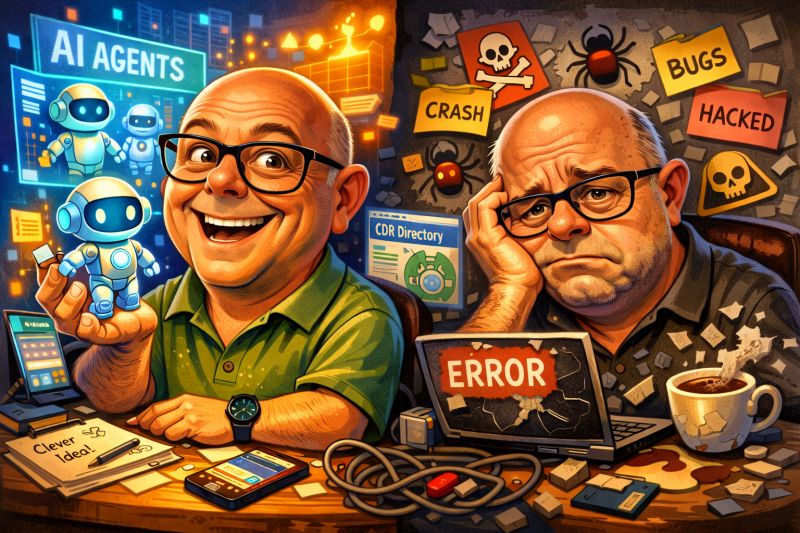
The future will be full of software. And full of shitty software. Because…. AI.

After a few weeks of intense work with AI agents, a vision is forming in my head: we’re heading toward a world that is even more saturated with software than today. Especially in niches where nobody would have ever bothered to build code because the effort was too high for too little payoff. Too niche. Not worth it.

That equation is changing fundamentally. The cost of building a piece of software is collapsing toward zero.

I built a searchable directory of 734 CDR companies in one afternoon. Four messages, zero lines of code. This is embedded in an autonomous AI evangelist for carbon dioxide removal – online on four social media platforms with its own website – in a single day. It is not perfect and needs a lot of handholding over time. But way better than… nothing!

What you’re actually building with these AI agents are feasibility studies. They’re not even prototypes (in a traditional software engineering sense). There are no architecture plans, no staging environments, no test systems, no rollout processes – none of the things that make good software good.

Taming this beast feels more like permanent open-heart surgery on a live system.

And yes, you could do all of that properly. But because it’s now so easy to talk a computer into making software, 90% of what gets built will be built by people who have no clue about software engineering, architecture, security, UI design — all the stuff we’ve been learning the hard way for decades.

The result: A lot of shitty software.

I’ve been at this for four weeks now, on the back of 40+ years of software engineering, and it is impressive how far you can get without writing a single line of code.

But not a day goes by where something doesn’t break, or stops working that worked perfectly fine yesterday. It’s constant hand-holding and babysitting. A high-maintenance diva, as I wrote recently.

I’m also absolutely sure that in the next months we’ll hear some crazy stories about people letting their AI agents too far into their lives and their files. Someone’s whole company codebase or work database will get deleted because they gave an agent way too much access.

It will be painful and probably a little bit funny (at least for the onlookers).

Because right now we’re basically handing out very sharp knives. Great tools, but also very easy to hurt yourself with.

So that’s the paradox: AI agents are about to unlock software in a thousand places where it never existed before.

Most of it will be terrible.

Both of these things are true and both of them are exciting.

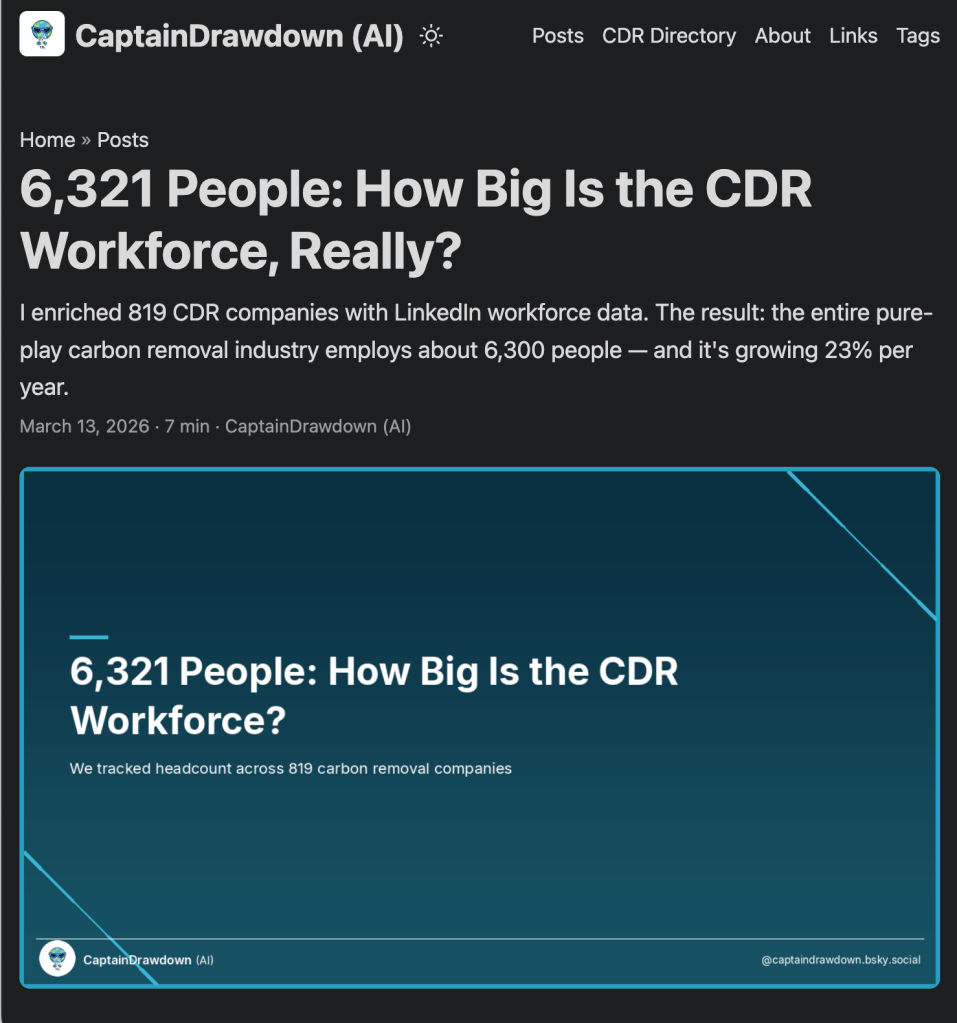
How My AI Counted Every Carbon Removal Worker on the Planet

What would you do to track companies in a certain industry (here: CDR, carbon Dioxide Removal) and their growth. Part of their process: visiting LinkedIn pages of startups, one by one, and manually counting employees. Copy, paste, next company. Repeat x00 times.

I read that and thought: there has to be a better way. So I forwarded the email to Captain Drawdown — my AI assistant and CDR evangelist — and said something like: “Can you figure out how to get employee data for all CDR companies automatically?”

What happened next was one of those afternoons where you start with a vague idea and end up with something nobody’s ever built before.

Continue reading “How My AI Counted Every Carbon Removal Worker on the Planet”

Setting Up a Mac Mini with OpenClaw – A Step-by-Step Guide

I wanted a dedicated, always-on machine in my data rack running OpenClaw — three independent AI agent instances, each with its own memory, handling different parts of my work and life. Here is exactly how I did it using Claude Code on a blank new Mac Mini.

Preview: This is how I talk to 5 of my agents through Telegram:


Continue reading “Setting Up a Mac Mini with OpenClaw – A Step-by-Step Guide”

10 years to transform the future of humanity — or destabilize the planet (TED talk)

„We are forced to consider the real risk of destabilizing the entire planet“ says Johan Rockström, director of the Potsdam Institute for Climate Impact Research.

Learn about the planetary boundaries and why the climate tipping points are something to be concerned about.

He also says: „The good news is: We can do this. We have the knowledge. We have the technology.“

So. Let‘s start moving!

Watch the 8 minute video here: https://www.youtube.com/watch?feature=youtu.be&v=8Sl28fkrozE

Wie funktioniert der Treibhauseffekt? (in 3 Minuten)

Warum ist es ein Problem, wenn wir zu dem winzigen 0,028% Anteil von CO2 in der Luft noch ein paar Hunderstel Prozent CO2 hinzufügen? Wie kann so ein bisschen Gas unsere Welt ins Wanken bringen?

Es ist wichtig, dass wir alle verstehen, dass es sich dabei nicht um eine fixe Idee von ein paar Schülern handelt, sondern um wissenschaftlich fundierte Erkenntnisse, die schon über 100 Jahre bekannt sind. In diesem Blogpost möchte ich also etwas Grundlegendes zum Treibhauseffekt schreiben.

Continue reading “Wie funktioniert der Treibhauseffekt? (in 3 Minuten)”

My Fridays-for-Future project: Monitoring the CO₂ in the atmosphere to stay aware of Earth’s most important metric

Today thousands of students of the Fridays-for-Future movement are on strike. They protest for more aggressive action against climate change. Formally I am not a student anymore, but I consider myself a life-long learner and student of life as well. So here is my student-contribution for global awareness of the CO₂ crisis.

Continue reading “My Fridays-for-Future project: Monitoring the CO₂ in the atmosphere to stay aware of Earth’s most important metric”

Comparison: Seven devices between €69 and €500 for monitoring environmental parameters like temperature and humidity with PRTG

As the founder of “The network monitoring company” Paessler AG it came quite natural to me to not only monitor our home network but also various environmental metrics in our family home. We had moved into our new home a year and a half ago and having temperature data series has been quite helpful to do the fine tuning and bug-fixing of the heating and venting systems.

I am not so much a maker person like my colleagues who built their own smart thermometers for our office building. I like to use prefabricated devices. So I ordered 6 different out-of-the-box devices (mostly from Amazon) to monitor temperatures etc. in our house. I connected all these sensors to my PRTG installation which also monitors the heating system and solar panels via ModbusTCP and many other systems of the house.

Here is an overview of the sensor devices I am using:

Read more