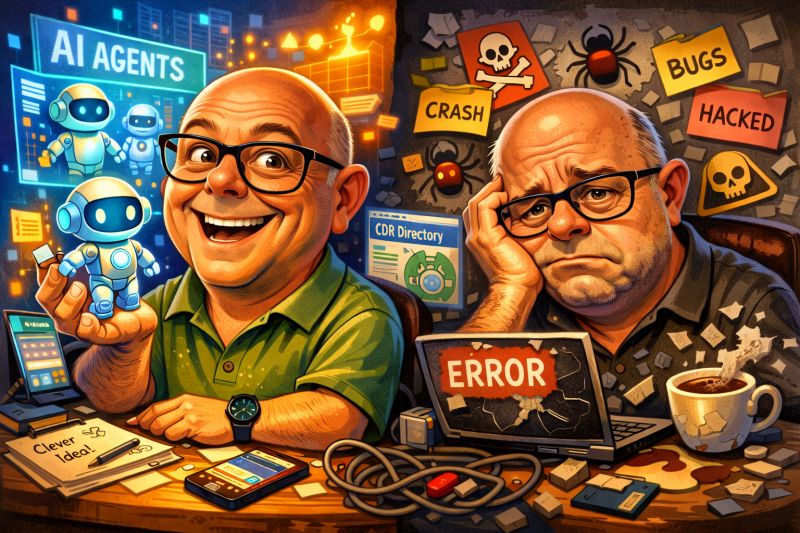
After a few weeks of intense work with AI agents, a vision is forming in my head: we’re heading toward a world that is even more saturated with software than today. Especially in niches where nobody would have ever bothered to build code because the effort was too high for too little payoff. Too niche. Not worth it.
That equation is changing fundamentally. The cost of building a piece of software is collapsing toward zero.
I built a searchable directory of 734 CDR companies in one afternoon. Four messages, zero lines of code. This is embedded in an autonomous AI evangelist for carbon dioxide removal – online on four social media platforms with its own website – in a single day. It is not perfect and needs a lot of handholding over time. But way better than… nothing!
What you’re actually building with these AI agents are feasibility studies. They’re not even prototypes (in a traditional software engineering sense). There are no architecture plans, no staging environments, no test systems, no rollout processes – none of the things that make good software good.
Taming this beast feels more like permanent open-heart surgery on a live system.
And yes, you could do all of that properly. But because it’s now so easy to talk a computer into making software, 90% of what gets built will be built by people who have no clue about software engineering, architecture, security, UI design — all the stuff we’ve been learning the hard way for decades.
The result: A lot of shitty software.
I’ve been at this for four weeks now, on the back of 40+ years of software engineering, and it is impressive how far you can get without writing a single line of code.
But not a day goes by where something doesn’t break, or stops working that worked perfectly fine yesterday. It’s constant hand-holding and babysitting. A high-maintenance diva, as I wrote recently.
I’m also absolutely sure that in the next months we’ll hear some crazy stories about people letting their AI agents too far into their lives and their files. Someone’s whole company codebase or work database will get deleted because they gave an agent way too much access.
It will be painful and probably a little bit funny (at least for the onlookers).
Because right now we’re basically handing out very sharp knives. Great tools, but also very easy to hurt yourself with.
So that’s the paradox: AI agents are about to unlock software in a thousand places where it never existed before.
Most of it will be terrible.
Both of these things are true and both of them are exciting.


